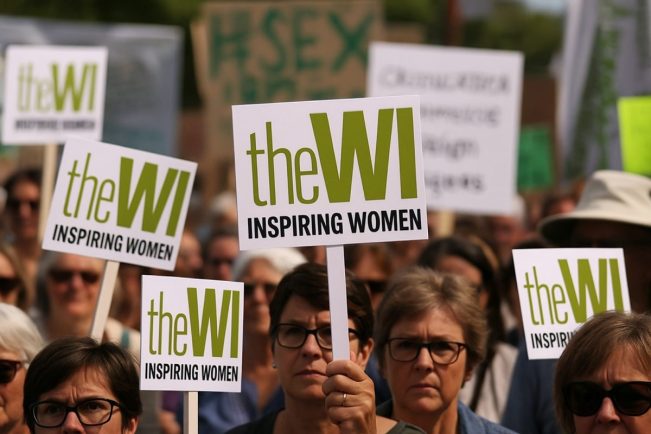
The Women’s Institute has announced it will stop accepting transgender women as formal members from April 2026, saying it can no longer do so legally following a landmark Supreme Court judgment.
The National Federation of Women’s Institutes revealed the change on Wednesday, stating that membership can no longer be offered to biological males after the court ruled in April that, under the Equality Act, the legal definition of a woman is based on biological sex rather than gender identity.
Melissa Green, chief executive of the NFWI, said:
“It is with the utmost regret and sadness that we must announce that, from April 2026, we can no longer offer formal membership to transgender women.” She added that the organisation would introduce new programmes “to continue to extend fellowship, sisterhood and support to transgender women”.
However, the news is welcomed by some.
“It is completely right, and frankly overdue,” said one long standing WI member. “Why do we have to open our doors to men who identify as women? I have no problem with anyone transitioning, people should live how they choose, but chromosomally they are still male or female. The Women’s Institute is for women. It feels like common sense at last.”
Current transgender members will not be removed, but their memberships will not be renewed when the change takes effect. A spokesman said the organisation would work with those members “to support them and to clarify the details of our new membership policy”.
The decision comes as the Government faces growing criticism for delaying updated guidance from the Equality and Human Rights Commission which is expected to clarify how single-sex services should operate after the Supreme Court ruling. Reports suggest the guidance may allow providers to question whether trans people should use certain facilities based on their physical appearance.
This new code of practice is intended to guide organisations such as councils, NHS trusts and private businesses when providing separate-sex spaces including toilets and changing rooms. Many bodies have continued to permit trans women to use female-only facilities despite the ruling, leaving service providers uncertain about how to proceed until the updated guidance is published.
Ms Green said the WI’s future depended on acting in line with the law. “As an organisation that has proudly welcomed transgender women into our membership for more than 40 years, this is not something we would do unless we felt that we had no other choice,” she said.
“To be able to continue operating as the Women’s Institute, a legally recognised women’s organisation and charity, we must act in accordance with the Supreme Court’s judgment and restrict formal membership to biological women only. However, this change is only in respect to our membership policy and does not change our firm belief that transgender women are women.”
Speaking on Woman’s Hour, she acknowledged the emotional weight of the decision.
“It’s a difficult decision because there’s legal aspects, there’s social aspects, but ultimately the WI is a women’s organisation. We’re a campaigning organisation, we’re an educational organisation. But it’s based on friendship and deeply rooted connections, and some of our transgender members have been with us for four decades, they’ve been part of the family.”
A further statement said the WI had worked with legal advisers since the ruling “to understand its impact” and to determine how to “maintain our sisterhood with transgender women”, adding that “all options” were explored before deciding to change the membership rules. Although the WI is still waiting for the EHRC’s formal guidance, it said it had “done our due diligence as an organisation and taken independent legal advice”.
Girlguiding also announced this week that it would bar biological boys from joining, calling it “the difficult decision”.
Helen Joyce, from the campaign group Sex Matters, said there were many other charities focused on transgender people. She said:
“Just a day after Girlguiding accepted that its charitable mission was focused on girls, not boys who say they are girls, Women’s Institute has followed suit and will exclude men who say they are women from its membership. If women, or men, want to join mixed-sex groups, there are plenty available. There are also plenty of charities that solely serve trans-identifying people. What is distinctive about single-sex groups is obviously lost if people of the opposite sex are admitted.”
The EHRC submitted an amended 300 page guidance document to Women and Equalities Minister Bridget Phillipson in September. Critics have accused Labour of delaying its publication to avoid internal conflict after details were leaked last month. According to The Times, the guidance would allow hospitals, gyms and leisure centres to question transgender women about their use of single-sex services based on appearance, behaviour or concerns raised by others. It also reportedly states that trans people should not join single-sex sports competitions based on their gender identity.
Once approved by ministers, the revised code must sit before Parliament for 40 days before coming into force. The guidance, last updated in 2011, covers organisations such as shops, prisons, cinemas, hospitals and charities that provide public services.
Responding to criticism, Ms Phillipson said she is “thoroughly and carefully” considering the guidance.
Main Image: For illustration purposes only