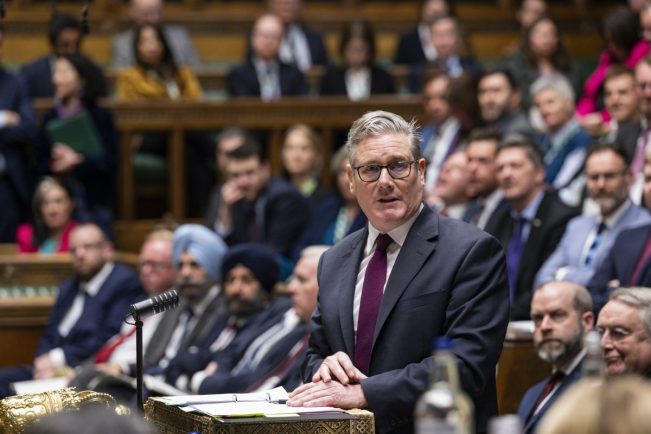
Sir Keir Starmer has said it is Ed Miliband’s decision whether Britain drills for oil and gas in the North Sea, as political pressure mounts over rising energy costs.
The Prime Minister insisted he does not have the authority to approve new licences, arguing that the final decision rests with the Energy Secretary under existing legislation.
His comments came during a heated exchange at Prime Minister’s Questions on Wednesday, where Conservative leader Kemi Badenoch accused him of avoiding responsibility.
Mrs Badenoch said Sir Keir could “make the decision today” and claimed he was “hiding behind” Mr Miliband. She added, “So will the Prime Minister approve the licences or is the Energy Secretary running the Government?”
The dispute centres on potential new extraction at the Rosebank and Jackdaw oil and gas fields in the North Sea. Both projects had previously been approved by the last Conservative government and accepted by Labour, but have been stalled since a Scottish court ruled in January last year that further environmental assessments were required before any extraction could proceed. The ruling means new licences would be needed.
Sir Keir defended his position by pointing to the legal framework governing such decisions. He said, “It’s absolutely clear that the quasi-judicial duty of the legislation rests with the Secretary of State.”
He added that the long term solution to high energy prices lay elsewhere, saying, “The only way forward is to go further and faster on renewables and the leader of the Opposition’s approach is to outsource our foreign policy and let the US decide whether we go to war, to outsource our energy policy to Russia and Iran and let them set the price of energy. I will never do that, because it’s not in the British national interest.”
The row comes as energy costs have surged following conflict involving Iran, prompting renewed calls, including from US president Donald Trump, for the UK to expand domestic oil and gas production. Mr Trump has described the North Sea as a “treasure chest” and warned that British energy prices were “through the roof”.
Despite this, Mr Miliband has maintained his opposition to new North Sea drilling. He has argued repeatedly that expanding extraction would not reduce household energy bills, stating previously that “new exploration licences in the North Sea, which some people are calling for, will not take a penny off people’s bills”.
Mrs Badenoch challenged that stance, highlighting the potential impact of the Jackdaw field. She said, “The Jackdaw gas field could be up and running before winter. All that gas would be used here in the UK to heat 1.6 million homes, that is enough to power Norfolk, Suffolk and Essex put together.”
She also accused the Prime Minister of weakness, saying, “He is the Prime Minister, he can make the decision today, he can. He is so weak, he’s the first person to be pushed around by the Energy Secretary.”
The debate has intensified scrutiny of Mr Miliband’s influence within government, with critics suggesting he holds significant sway over energy policy. He has also faced pressure from within Labour, including unions concerned about the future of jobs tied to North Sea oil and gas, which support more than 200,000 roles directly and indirectly.
At the same time, senior figures in government are understood to be divided. Chancellor Rachel Reeves is reported to be among those pushing for North Sea resources to be unlocked, while Mr Miliband risks opposition from Labour backbenchers and climate campaigners if he approves new licences.
Industry voices have also weighed in. RenewableUK, the wind energy trade body, has urged ministers to “take energy out of the culture wars” by increasing North Sea production, while Conservative figures have accused Mr Miliband of holding a “cult-like conviction” on net zero policies.
Writing earlier this week, shadow energy secretary Claire Coutinho said it would be “lunacy” not to accelerate drilling at Rosebank and Jackdaw given the current energy crisis.
Sir Keir, however, reiterated that while oil and gas would remain part of the UK’s energy mix for years to come, the government’s priority was shifting towards cleaner sources. He said, “Oil and gas is coming out of the North Sea 24/7. It will be part of the energy mix for many years to come. We fully support all existing oil and gas fields throughout their lifespan… But we need to take control of our energy prices. The only way to do that is through renewables.”
Main image: https://creativecommons.org/licenses/by-nc-nd/4.0/