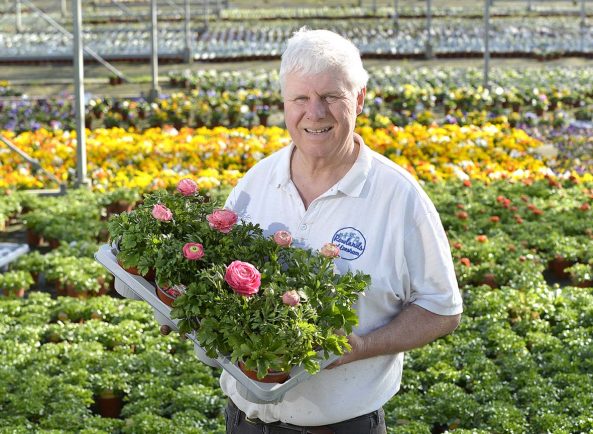
In the latest edition of our farmer and grower column, Field of View, Tony Rowland of Rowlands Plants talks about the issues encountered in running a small commercial horticultural business.
By Tony Rowland
WE ARE a small family nursery based at Knowle Hill in Badsey, producing ornamental plants primarily for the wholesale trade.
Last year we launched a mail order business to improve the profit margins on the lavender, pansies, fuchsias and other plants we produce, and making them more accessible to home gardeners.
Our family has been supplying British garden centres and nurseries since 1957 and we significantly expanded our wholesale plant growing operation during lockdown.
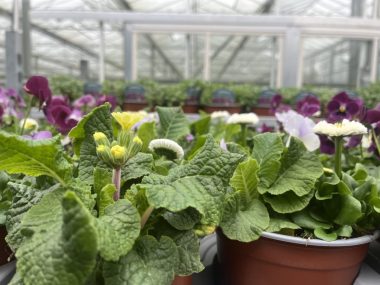
Spring breaks, a mix of three plants in a pot grown at Rowlands Plants. s
There was an obvious commercial opportunity due to anticipated issues in the supply chain regarding the importation of plants from The Netherlands, the dominant supplier of floriculture products to the UK.
A hugely topical subject at the moment is the topic or energy costs.
We predominantly use electricity in our nursery, which is bad enough. The salad producers in the Vale have a very heavy heat load to grow salad crops around the year.
The Iranian war has just shown how volatile energy costs are, one local garage has been seen selling diesel at £2.01 per litre.
Imagine what impact that would have if you were heating a large glasshouse, perhaps extending to five to 10 acres. It would be enough to completely alter the profitability of the business. And profit margins in this industry are slim.
A few years ago, we fell out of contract with our electricity supplier and the result was eye watering. Our response was to look at being self-sufficient, so we installed solar panels on the shed roof.
We export the surplus energy to the grid, and then pay for it to be supplied back to us at night when the panels lie dormant.
For most of the year, these panels have taken much of the sting out of the electric bills, so it would seem to be a worthwhile investment.
The Vale of Evesham has long been known as an intensive production area in middle England.
Most of the major UK conurbations lie within 70 miles of Evesham, making it an ideal location for transport companies. This geographical advantage continues today, and you regularly see articulated lorries trundling through the local villages, whilst they make their way to the A44 and A46 trunk roads.
These lorries have a significant impact on households, and there isn’t much they can do to mitigate this.
Wouldn’t it be nice if there was a bit more flexibility in the planning system to allow these transport companies to move to more isolated sites away from residential houses?
Another big issue looming large is the mandatory use of peat free compost on ornamental nurseries.
Peat free compost tends to be more expensive to buy. You have to continually feed the plants to make sure they grow, and it is difficult to see how the supply side can provide enough peat-free compost to serve the horticultural sector using it.
Is it a good thing to keep irrigating with fertiliser, as a lot can run off into the water courses?
Our biggest problems are two fold, the changing weather patterns which make it difficult to predict future demand for plants, and economic uncertainty, which leads to a massive variation in demand for the product we produce.
So far we have survived, but it does seem increasingly more difficult to make an economic return on capital invested in the nursery.
I think the next few years will be make or break on the viability of the business. It would really help if we had a Government that was slightly sympathetic towards horticulture.
Still, you always have to have a wish list don’t you?