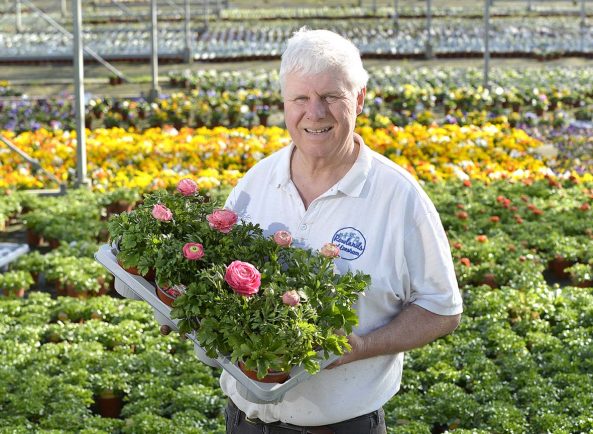
This month, Tony Rowland of Rowlands Plants at Badsey talks about how to make the most of your border plants and explains how best to garden when using peat-free compost.
By Tony Rowland
A FEW weeks ago, when relaxing after a hard day’s work at the nursery, I listened to Gardner’s Question Time. A chap asked for advice on what to do to rescue his veg plants. They were yellow and looked stunted.
When quizzed about what they were growing in, it turned out that he had been using a peat-free compost.
The advice returned, suggesting that he feed the veg plants with a balanced feed, a typical 20:10:10 fertiliser – two parts of nitrogen to one part potassium, one part phosphorus.
There is a lot of pressure being put on our horticultural Industry to get commercial growers to use peat-free compost.
Personally, I use bulrush compost and have reduced my peat content to 50 per cent, using other filler materials such as wood chips.
The problem with peat-free compost is that it comprises mostly wood chip, coir, and other inert organic material.
If the plants dry out, the conductivity levels – the concentration of fertiliser – soar, which can lead to scorch.
If the plant isn’t continually fed, the level of fertiliser in the compost falls, and the plant then starts to lose condition, leaves start to turn yellow, and it can look starved.
So, if you are holding plants for any length of time, you feed lightly and often, so that the plants remain in good condition, ideal for planting out in the border.
Buy a proprietary feed, and put a tablespoon of fertiliser into a good-sized watering can. Mix in well, and apply as a drench.
Because of the fertiliser content, this is best done in the evening, or on a dull day, so that you don’t scorch the leaves.
To keep soil moist in this heat, use an organic mulch like woodchips or garden compost, which reduces evaporation as well as suppresses weeds.
Investing in plants is normally a big decision. As a nurseryman, I always joke that we have plants looking for surrogate parents, that is, keen gardeners who will look after them for the duration of the growing season.
We are past the frost season, so now is the ideal time to plant new plants in the border, so that they establish quickly, and look good for the summer period.
Again, once planted, feed lightly and regularly to get the best growth.
A lot of attention in the garden should also be given to the soil condition and improving its friability to get the best results from your endeavours.
The most important component of soil, believe it or not, is air. Plant roots need oxygen to live and work.
A lumpy, solid clay, as found locally in the Evesham area, is the Fladbury series soil. This is usually devoid of air, organic matter, and quite often lies waterlogged, making it a very inhospitable environment for the roots to work in.
Gardeners can improve their soil by adding organic matter, enhancing the earthworm activity, and making sure there is proper drainage in the soil profile.
So the back-breaking work back in the winter period will pay dividends over the growing season.
With care and attention given on an annual basis, you will be able to really create a first-class loam soil, no matter where your garden is.
This, in turn will make you more inclined to buy plants to make your garden borders look attractive.
It is very much the old adage, the more you put in, the more you will get out of your garden space.
May I wish you a happy gardening season.