Britain has granted the United States permission to use its military bases for what ministers described as limited defensive operations against Iran, marking a significant shift in the UK’s position as fighting intensifies across the Middle East.
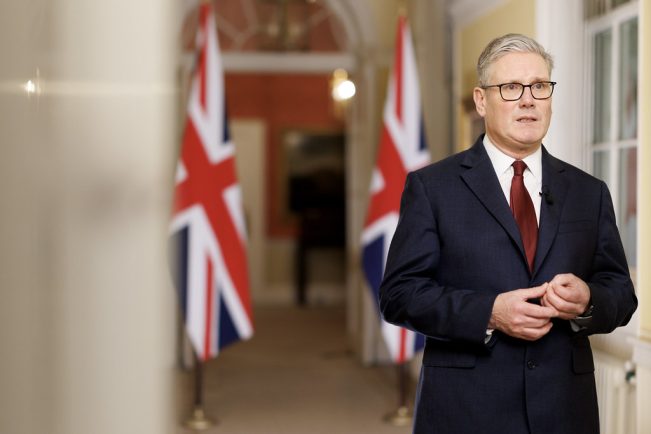
Sir Keir Starmer confirmed the decision in a video statement posted on X, saying Washington had requested access to British facilities for specific defensive purposes. He said the government had agreed in order to prevent Iran from launching further missile attacks across the region, which he said were endangering civilians, British nationals and countries not involved in the conflict.
The Prime Minister said Iran had carried out sustained strikes over two days against states that had not initiated hostilities. He added that airports and hotels used by British citizens had been hit, placing at least 200,000 UK nationals in the region at risk, including residents, holidaymakers and those in transit.
In a joint statement issued earlier with France and Germany, the UK signalled for the first time that the three countries could support US and Israeli strikes on Iranian soil. The statement said they would take steps to defend their interests and those of regional allies, including enabling necessary and proportionate defensive action to destroy Iran’s capacity to launch missiles and drones at their source. The three governments said they had agreed to work with the US and partners in the region.
The decision represents a reversal of the government’s earlier stance. Britain had previously declined US requests to use bases including RAF Fairford and the British controlled facility at Diego Garcia in the Chagos Islands, citing concerns over international law. That refusal prompted criticism and led President Donald Trump to withdraw support for Starmer’s proposed agreement to transfer sovereignty of the British Chagos Islands to Mauritius.
Former Defence Secretary Sir Grant Shapps said:
“A welcome U-turn from the PM as he finally agrees to UK bases being used to protect British interests under attack from Iran. Quite why it’s taken him two days to make the most obvious decision of his premiership is another matter!”
The change in policy followed heavy bombardment in Iran and retaliatory Iranian strikes on Gulf states. Priti Patel, the shadow foreign secretary, accused the Prime Minister of failing to act proactively with American allies, saying the Iranian regime posed open threats to the UK, regional partners and the United States.
Military action intensified after the reported killing of Iran’s Supreme Leader, Ali Khamenei, prompting further waves of Iranian missiles and drones targeting Israel and several Gulf states, including Bahrain, Oman, Kuwait, Qatar and the United Arab Emirates. Parts of Tehran were struck as US naval and air forces sought to establish air supremacy.
Within 48 hours of the escalation, US and Israeli forces said they had killed senior Iranian military leaders, destroyed dozens of missile launchers, sunk nine naval vessels and dismantled a major explosives facility. The United States confirmed its first casualties, with three soldiers killed and five wounded.
President Trump said Iran’s interim leadership had indicated a willingness to enter ceasefire talks. He stated that the military campaign had been planned to last up to four weeks, or less if Tehran agreed to a nuclear deal. In a video message, he said operations would continue until all objectives were achieved and urged members of Iran’s Revolutionary Guard and security forces to surrender, warning they would otherwise face death.
The conflict has disrupted global energy markets. Shipping through the Strait of Hormuz, which carries around a fifth of the world’s oil supply, has halted. Analysts have warned that Brent crude prices could rise sharply, potentially reaching 100 dollars a barrel if fighting continues.
On Sunday an RAF Typhoon was scrambled to intercept a Shahed drone heading towards Qatar. British ministers are preparing plans for what could become one of the largest evacuations of UK nationals since the Second World War.
Sir Keir said the government’s actions were consistent with international law and published a summary of its legal advice. The document stated that the UK was acting in collective self defence of regional allies who had requested assistance, and that its support was focused solely on ending missile and air attacks against states unlawfully targeted by Iran. It said the move did not signal broader UK involvement in the wider conflict between the US, Israel and Iran.
The Prime Minister has faced criticism from both sides of the political spectrum. Some Labour figures, including Emily Thornberry, chair of the foreign affairs committee, described the strikes on Iran as illegal and ill advised. Richard Burgon, a Labour MP, called them an illegal act of aggression. Zack Polanski, leader of the Green Party, and Jeremy Corbyn, now head of Your Party in the Commons, also condemned the attacks as unlawful and aimed at regime change.
On the Conservative benches, Lord Wolfson, the shadow attorney general, questioned the government’s interpretation of international law and suggested the Prime Minister was not bound to adopt a cautious position.
Outside Downing Street, some members of the Iranian diaspora expressed support for US and Israeli action. International leaders have also weighed in. Canada’s Prime Minister Mark Carney said he supported the United States in preventing Iran from acquiring a nuclear weapon and threatening international security. Similar statements were made by Australia’s Prime Minister Anthony Albanese and Ukraine’s President Volodymyr Zelensky.
As diplomatic efforts and military operations continue, the situation remains volatile, with governments across the region bracing for further escalation.
Image Licence: https://creativecommons.org/licenses/by-nc-nd/4.0/