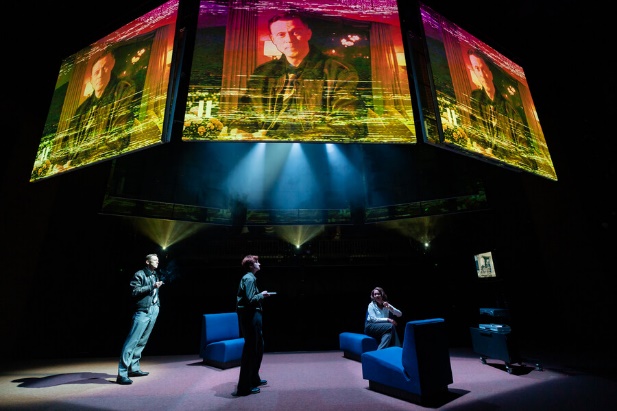
THE SHADOWY and troubling world of the political strategist is forced into a stark, analytical light in David Edgar’s new work at the Other Place.
We’re in post Berlin Wall eastern Europe watching two American election puppet masters battle each other and any semblance of the truth to get their candidate over the line.
Complex readings of the electorate’s key wishes and subtle employment of branding, repetition and image all come to the fore as this involved but nevertheless compelling war is waged.
Coming some eight years after the Brexit vote and seven years after Trump’s team manufactured its way into the White House, this dissection of dirty politics is far from topical. The sophistication of the technology used may increase but a lie will always be a lie.
Though the last few decades of US presidential clashes forms the background here, the spectre of Dominic Cummings and the role of Cambridge Analytica looms.
The moral question of whether the end justifies the means when it comes to politics is a subject covered widely and effectively down the years from Richard III to Yes Prime Minister.
Perhaps if we saw more transparently the backstabbing chicanery which underpins every outwardly laudable campaign, the turnout of voters would drop even further below the low level that distrust and cynicism create at the moment.
But the message here seems to be that the more we do see, the less we seem able or even willing to do. The manipulators will always be one step at least ahead of the manipulated.
It’s a criticism of the shallowness of many of our present day politicians that having power is clearly more important than anything you might actually do with it. That ‘win at all costs’ mentality is ruthlessly exposed in the tactics and attitude of the unashamedly mercenary campaign directors making things happen.
There are strong performances throughout. Martina Laird and Lloyd Owen as the one-time partners now fighting each other through their respective campaigns are both excellent. Both benefit from the odd moment away from argument and posturing to develop more rounded characters.
Despite that, in the last of many bitter but verbose exchanges between the two strategists it becomes apparent that we neither like nor fully trust either of them.
Elsewhere the cast master the full range of sinister politicos, egotistical candidates and – in one of the play’s more bizarre passages – the pleasingly over-politicised entry to that bastion of ideological conflict, the Eurovision Song Contest.
As a piece of theatre Edgar’s play is heavy on words and strong on confrontation. Holly Race Roughan’s direction plays principally on confrontation and Alex Lowde’s staging certainly emphasises that. Decent visuals and fine acting can’t entirely move this production away from some boggy areas.
One of the more memorable strategies used so effectively in many recent elections is the idea of keeping things brief to get a message across. Ironically in its lengthy and relentless progress this play ignores brevity for exhaustive explanation and, as a result, at times becomes a little preachy.
A judicious spot of pruning and a healthy reduction in the tendency to overstuff the theoretical content might make a slimmer, more clearly targeted manifesto we could all vote for.
Matthew Salisbury