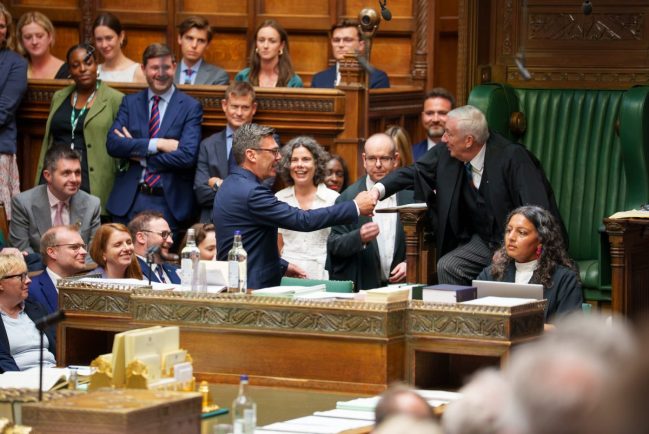
Andy Burnham will be sworn in as prime minister on Monday, taking over from Sir Keir Starmer following an audience with King Charles.
His arrival in Downing Street will make him the seventh person to lead the country in a decade.
Burnham was confirmed as Labour leader on Friday after securing the backing of 379 of the party’s MPs and all 11 trade unions affiliated with Labour, cementing his position as the sole candidate in the contest.
A rapid path back to power
Burnham’s rise has been swift. Until last month he held no seat in the House of Commons, having stepped down as an MP in 2017 to become mayor of Greater Manchester. His return to Westminster was engineered when a Labour ally, Josh Simons, resigned his Makerfield seat, triggering a by-election that Burnham went on to win. Under the rules governing metro mayors who also hold police and crime commissioner powers, his election as an MP automatically disqualified him from the mayoralty, and his deputy, Paul Dennett, took over as interim mayor.
That victory, coming on the back of heavy Labour losses in May’s local elections, intensified pressure on Sir Keir from his own backbenchers. Sir Keir announced his resignation as party leader shortly afterwards, saying he no longer believed he was the right person to lead Labour into the next general election.
Labour has trailed Nigel Farage’s Reform UK in the polls for roughly eighteen months, and many in the party are hoping that Burnham, a longstanding advocate for the north of England, can halt the slide.
Cabinet still being decided
Speaking to reporters on Friday, Burnham said he had not yet finalised the make-up of his top team, arguing that setting out appointments before formally taking office would be disruptive. He said his choices would reflect the breadth of the party and the country, and that the full line-up would be announced on Monday.
Speculation has focused on Ed Miliband and Shabana Mahmood as possible successors to Rachel Reeves as chancellor, though nothing has been confirmed.
Devolution and social care at the centre of his message
In his first speech as party leader, delivered at the TUC’s central London headquarters, Burnham promised to restore “hope” to working class communities and pledged to shift power away from Westminster and towards the regions, a theme that has run through his campaign from the outset.
He was critical of the economic approach pursued by successive governments over the past four decades, including those he served in, and said his administration would prioritise “problem solving rather than point scoring”. He also appealed for party unity, warning that Labour could not defeat the resurgent right if it remained divided.
Away from the podium, he told reporters that reforming England’s social care system would be an early priority, describing it as an area that governments of all stripes have avoided tackling. He linked the issue to his own family’s experience, noting that his father has Alzheimer’s. Because social care is a devolved matter, any changes he pursues would apply to England only.
Burnham has pressed for an overhaul of the sector before. As health secretary under Gordon Brown, he set out plans shortly before the 2010 election for a National Care Service that would have been free at the point of use.
Debt record in Manchester
Burnham’s tenure as mayor has also drawn scrutiny as he prepares to take office. Government figures show the Greater Manchester Combined Authority’s outstanding borrowing stood at £1.34 billion at the end of the last financial year, up from £964 million before he became mayor in 2017, the largest debt of any combined authority in England. Adjusted for population, that works out at £462 per resident, the second highest of any combined authority nationally. The bulk of the borrowing has gone towards capital projects, including the Bee Network integrated transport system and housing and regeneration schemes.
Shadow housing minister Sir James Cleverly said Burnham was leaving behind an authority “weighed down” by debt while proposing similar spending plans in national government. A spokesperson for the Greater Manchester Combined Authority defended its financial position, pointing to the scale of the region’s devolution deal, which involves annual spending of more than £3 billion.
Political reaction
The response from opponents was swift. Conservative Party chairman Kevin Hollinrake called on Burnham to recall Parliament, which is in recess until September, so that MPs could question him on his plans. Linda Hobson of Unison, one of the unions that backed Burnham’s leadership bid, urged him to deliver on the optimism he has promised to bring to government.
Burnham used part of his speech to pay tribute to Sir Keir, crediting him with strengthening workers’ and renters’ rights, reducing NHS waiting lists and returning rail services to public ownership.
Full details of his cabinet, and the policy priorities he intends to pursue in office, are expected once he formally takes charge on Monday.