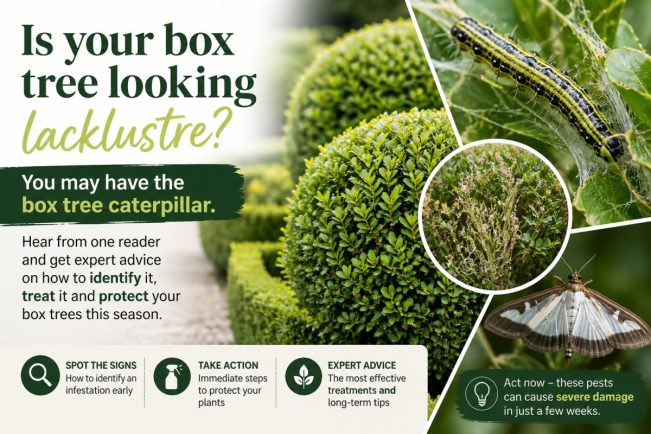
Have you noticed your box trees looking a little lacklustre this spring? You may have the dreaded box tree caterpillar.
Across the UK, gardeners are reporting once-pristine box plants suddenly turning dull, patchy and, in some cases, completely stripped of leaves. The culprit is the invasive Box tree moth, whose fast-moving caterpillars can devastate hedges and topiary in a matter of days.
In this piece, one reader shares their experience of discovering an infestation in their own garden, after decades of trouble-free growth, and the shock of seeing cherished box plants rapidly decline. We also speak to experts about how to identify the problem early, what steps to take immediately, and the most effective ways to protect your plants through the season. If your box is looking “not quite right”, now is the time to take a closer look.
A READER’S EXPERIENCE:
We have a couple of box trees that must be at least 40 years old, beautiful, sculpted things that have always been the pride of our garden.
Every spring, without fail, they are the first to come into their own, glowing with that vivid, almost luminous green that signals the season has properly begun.
But this year was different.
At first, I couldn’t quite put my finger on it. They just looked… lacklustre. Not terrible, just not themselves. I assumed they needed a feed after the winter. But as the days passed, they seemed to get poorer and poorer. Then I noticed something worrying, the other box plants were starting to look off too. Even the box hedge at the front of the house had lost its usual vibrancy.
I did what many gardeners would do: I rushed to the garden centre and bought plant food, convinced it was a nutrient issue. But then someone mentioned the words no box owner wants to hear: the box tree caterpillar.
I went home and took a closer look. What I found was astonishing.
Hidden deep inside the plants were hundreds, if not thousands, of small green caterpillars, tucked away in webbing, quietly devouring everything. They are the larvae of the invasive Box tree moth, a pest that has spread rapidly across the UK in recent years. Until now, we had somehow escaped them.
Not anymore.
I tried the obvious first step, hosing them off, but it barely made a dent. They are incredibly sneaky, hiding right in the centre of the plant or under branches where you can’t easily reach them. So my father and I decided to tackle it head-on.
We spent an entire day picking them off by hand.
It felt endless. Every time we thought we’d made progress, we’d part the branches and find dozens more. We filled a plastic container again and again. I really didn’t want to kill them and briefly considered taking them somewhere else, but a quick bit of research (and, I admit, advice from AI) made it clear that releasing them would simply spread the problem to someone else’s garden. Each moth can lay hundreds of eggs. Moving them on isn’t a kindness, it’s just passing the damage along.
In the end, the recommended method was a bowl of soapy water, which dispatches them quickly and prevents further spread. My father took on that part.
It’s still early days, and we don’t yet know how many of our plants will survive. Some are stripped almost bare. But there is a glimmer of hope: if there is still green in the stems, there is a chance they will recover. Box is tougher than it looks.
For now, we’re continuing the manual removal every few days, checking deep inside the plants where the caterpillars hide. I’ve also ordered a biological treatment containing Bacillus thuringiensis (often sold as Xentari), which specifically targets caterpillars. It was surprisingly difficult to find, I couldn’t get it on Amazon and ended up sourcing it via eBay, which seems to be the reality for many UK gardeners facing this issue.
The hard truth is that this is not a one-off battle. The moth has multiple generations each year, so vigilance is required throughout the summer.
Our magnificent box trees may not look quite so magnificent right now. But we’re not giving up on them yet.
And if this experience has taught me anything, it’s this: if your box plants suddenly start to look “a bit off” in spring, don’t wait. Look inside. Because by the time the damage shows on the outside, the problem is already well underway.
What The Experts Say:
Gardeners across the UK are increasingly encountering a destructive new pest: the caterpillars of the Box tree moth.
Once rare, the insect has spread rapidly since its arrival in Britain in the late 2000s, and it is now widely established across much of southern England and parts of the Midlands.
Box plants (Buxus), prized for their dense evergreen foliage and traditional use in formal hedging and topiary, are the moth’s primary, and almost exclusive, host. From clipped “pom-pom” shrubs to low hedges lining front gardens, these plants have become particularly vulnerable to attack.
A Sudden and Severe Threat
The damage caused by box tree caterpillars can appear alarmingly quickly. The larvae (caterpillars), greenish-yellow with black stripes, feed voraciously on leaves, often hidden within silk webbing spun inside the plant. By the time gardeners notice, foliage may already be stripped, leaving bare stems and a brown, desiccated appearance.
Multiple generations occur each year, typically beginning in spring. Warm conditions can accelerate development, allowing populations to build rapidly. Adult moths, white with brown-edged wings, are nocturnal and often go unnoticed, which contributes to the suddenness of infestations.
An Invasive Species
Native to East Asia, Cydalima perspectalis is considered an invasive species in Europe. It is believed to have been introduced via the horticultural trade. Unlike many native caterpillars, it has few effective natural predators in the UK, although some birds are beginning to include it in their diet.
Its spread has posed challenges not only for private gardeners but also for historic landscapes, formal gardens, and estates where box hedging is a defining feature.
Managing the Infestation
Control requires vigilance and early intervention. Experts recommend regular inspection of box plants from spring through autumn, paying particular attention to the interior of the foliage where caterpillars and webbing are most often found.
Manual removal is effective for small infestations. Caterpillars can be picked off by hand and disposed of (they suggest popping them into soapy water). Pruning heavily affected sections may also help reduce numbers.
For larger outbreaks, biological control is widely advised. Products containing Bacillus thuringiensis target caterpillars specifically and are considered one of the most environmentally selective treatments available. Applications must be thorough, reaching into the centre of the plant, and may need repeating as new generations emerge.
Pheromone traps can be used to monitor adult moth activity, providing an early warning of when egg-laying is likely to occur.
Recovery and Long-Term Outlook
Although heavily defoliated plants may appear dead, box can recover if some green growth remains. Light feeding and appropriate watering can support regrowth once the infestation is controlled. However, repeated attacks over successive seasons can weaken plants significantly.
Given the moth’s established presence, ongoing management is likely to be necessary. Some gardeners are choosing to replace box with alternative species that are not susceptible to the pest, though this represents a significant shift away from traditional planting schemes.
A Changing Garden Landscape
The spread of the box tree moth reflects a broader trend of invasive pests altering the character of British gardens. As climate conditions shift and global plant trade continues, similar challenges may become more common.
For now, awareness and prompt action remain the most effective tools. Gardeners who monitor their plants closely and respond quickly stand the best chance of preserving their box hedges in the face of this persistent and fast-moving threat.
The Royal Horticultural Society (RHS) encourages the public to report box tree caterpillar sightings via their online survey to track the spread of this invasive pest. With massive infestations reported in recent years, the RHS uses this data to map the pest’s expansion and study its impact.
For more details and advice from the RHS CLICK HERE