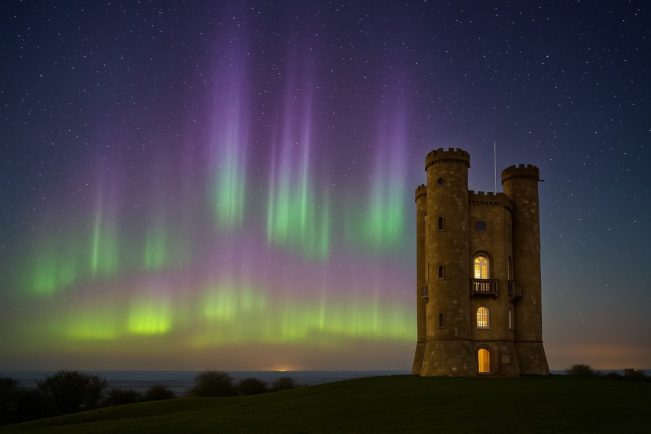
The Northern Lights have been visible across much of the United Kingdom this week, following a period of heightened solar activity that sent charged particles streaming toward Earth.
Sightings have been reported from northern Scotland to as far south as southern England, offering many people a rare opportunity to witness the aurora borealis without leaving the country.
While activity is expected to fluctuate in the coming days, forecasters say there are still promising chances of further displays, particularly in northern areas, and possibly beyond if conditions remain favourable.
What causes the Northern Lights
The Northern Lights occur when charged particles released by the Sun travel through space and interact with Earth’s magnetic field. These particles are drawn toward the polar regions, where they collide with gases in the upper atmosphere.
As these collisions occur, energy is released in the form of light, creating the glowing patterns seen in the night sky. The displays can take on many shapes, including arcs, rippling curtains, and spiralling bands, often shifting and changing within seconds.
Auroras typically form between about 80 and 250 kilometres above Earth’s surface, far above where weather occurs, meaning they are unaffected by winds or storms below.
Why the UK saw widespread displays this week
The UK does not usually sit within the main auroral zone, which is centred around the Arctic. However, during periods of strong solar activity, this zone expands southwards.
Recent eruptions on the Sun, known as coronal mass ejections, triggered geomagnetic storms as they reached Earth. These disturbances temporarily strengthened and expanded the aurora, allowing it to be seen much further south than usual.
Such widespread visibility across the UK is relatively uncommon, but it becomes more likely as the Sun approaches the peak of its approximately 11 year solar cycle, a period when solar activity increases.
What the different colours mean
The colours of the Northern Lights depend on which gases are involved and how high in the atmosphere the collisions take place.
Green is the most frequently seen colour and is produced when charged particles interact with oxygen at lower altitudes, roughly between 100 and 190 kilometres.
Red auroras appear higher in the atmosphere, often above 240 kilometres, and are usually linked to stronger solar events. They are less common but can be especially striking when visible.
Purple and pink tones are created when solar particles collide with nitrogen at mid range altitudes, often during more active or fast changing displays.
Blue is the rarest colour and forms at lower altitudes when nitrogen is excited. It is only occasionally visible and is often faint, making it harder to detect with the naked eye.
Each display is unique, shaped by the strength of solar activity and the composition of the atmosphere at the time.
How to see the Northern Lights in the UK
Catching the Northern Lights in the UK depends on both space weather and local conditions. Experts recommend:
- heading to dark locations away from artificial light, such as rural areas, coastlines or national parks
- looking north, with a clear and unobstructed horizon
- choosing nights with little or no cloud cover
- allowing time for your eyes to adjust to the darkness
- using a camera or smartphone, which can reveal colours not always visible to the naked eye
In southern parts of the UK, auroras may appear as a faint glow or subtle tint, while in northern regions they can be brighter and more dynamic.
Interesting facts about the Northern Lights
- The Northern Lights have a southern counterpart, known as the aurora australis, which occurs over Antarctica
- Ancient cultures often interpreted auroras as omens or messages, with some Norse myths linking them to warriors in the sky
- The lights can move at speeds of up to several kilometres per second, constantly reshaping as solar particles interact with Earth’s magnetic field
- Auroras are not unique to Earth, they have also been observed on planets such as Jupiter and Saturn
- Strong geomagnetic storms that produce auroras can sometimes affect satellite communications and GPS systems
Outlook for the coming days
Although solar activity is expected to ease slightly, conditions remain encouraging for further auroral displays in the UK. Even a modest increase in solar wind could bring the lights back into view, particularly in Scotland and northern England, with a chance of more widespread sightings if skies stay clear.
Auroras are naturally unpredictable, but that unpredictability is part of their appeal. With the Sun currently in an active phase, skywatchers across the UK may have more opportunities in the days ahead to look up and catch another glimpse of this remarkable natural phenomenon.
If you get any good photos, please do send them in, we may feature them in the paper.
Main Image: For illustration purposes only