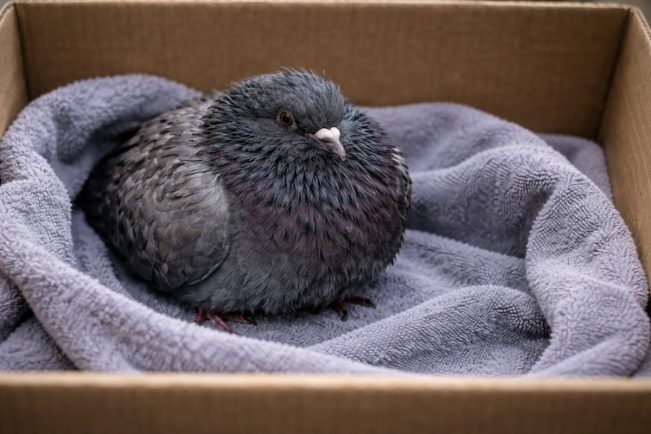
Last night, in the pouring Worcestershire rain, I discovered a miserable, puffed up pigeon sitting at the bottom of my tree looking like a feathered baked potato who had very much lost the will to live.
I went out looking like I was heading into battle, rubber gloves on, old towels at the ready, and a box held up like a riot shield as I advanced on what can only be described as a very soggy little bundle of despair.
I braced myself for flapping, chaos, and potential pigeon related carnage.
Instead… nothing.
He was as good as gold and let me scoop him up without so much as a flutter. At first, I felt triumphant, like some kind of reluctant wildlife warrior, but that quickly turned to worry. Was his perfect politeness a bad sign? Was he so poorly that he had simply given up?
Deciding I was not, in fact, an avian medical expert, I settled on the next best plan, a warm, dry box in the shed, door left open, and fingers crossed that my new lodger would feel well enough to check out by morning.
At first light, I tiptoed downstairs with my heart in my mouth, half expecting an empty box, or worse. Instead, two bright, watchful pigeon eyes followed me around the shed. Relief and disappointment collided. Relief that he was alive. Disappointment because I knew he needed more help than I could give.
So I scooped him up again, popped him into a cat carrier, and drove to Vale Wildlife Hospital near Tewkesbury, one of the most extraordinary places we are lucky enough to have on our doorstep.
Of course, because I am a fully qualified catastrophiser with a side hustle in hypochondria, the drive there was less “calm animal rescue” and more “scientific documentary about the start of a global pandemic.”
My brain skipped straight past “helping a pigeon” and landed somewhere around “Netflix documentary, The Worcestershire Outbreak.” Had I recently seen something about bird flu? Absolutely. Did I remember any of the actual facts? Absolutely not. Did that stop me? Also absolutely not.
Suddenly I was convinced this soggy pigeon was less “sad garden bird” and more “feathered biohazard.” Could bird flu jump to humans? Almost certainly, in my head. Was I about to become Ground Zero? I could already picture myself in a full hazmat suit on the six o’clock news, Local Woman Topples Society After Hugging Damp Pigeon. By the time I reached Tewkesbury, I had mentally quarantined the family, disinfected the car, and composed a stirring final speech about how I “died doing what I loved, rescuing baked potatoes with wings.”
I am, admittedly, dramatic.
So when I arrived at Vale and saw a clear sign on the hospital door instructing that all birds must be left outside for assessment, my heart very nearly leapt into my mouth. For a split second I thought, “Oh no… I was right.”
But immediately the professionalism and care at Vale were palpable. Because of avian health protocols, yes, birds must first be assessed in a separate portacabin before entering the main hospital, a quiet but vital line of defence against disease. But once my rain soaked friend was given the all clear to proceed, he was whisked inside for proper examination. No me starring in Netflix documentary just yet.
Then I met Tiff, a lovely American lady from California who now works at Vale, who gently explained the situation after vet Laura had inspected him. My pigeon has Trichomonosis (Canker) a parasite caused by a tiny organism called Trichomonas gallinae. It lives in the bird’s mouth, throat, and crop and causes lesions in his throat, which means he will need to be tube fed and closely monitored. The prognosis is not certain, but there is hope, and sometimes, hope is everything.
I left Vale that morning lighter in spirit than I arrived, clutching a reference number so I can check his progress online, a bag of bird seed, and a deep respect for the people who dedicate their lives to saving wildlife that many of us barely notice.
This was not my first visit to Vale. Last summer, a dazzling green woodpecker crashed into one of our windows. I was convinced he was either dead or on his way there. I scooped him up (yes, brave me, again) placed him in a box, and rushed to the hospital. To my astonishment, when they opened the box out back, “Little Lazarus” exploded into the room with a brand new lease of life. On the drive home, he was hammering my hand through the box like a tiny, furious carpenter, and I now fully understand why they are called woodpeckers. Another apt name would be “skin breakers.”
Even now, I still see him occasionally. He gives me a triumphant fly by as if to say, “Thanks for the Uber, human.”
Animals are astonishing, resilient, funny, fragile, and deeply precious. If you ever see one in trouble, please do not look away. And if you are able, please consider donating to Vale Wildlife Hospital. It costs around £70,000 a month to run, a staggering figure, but every penny goes toward saving creatures who have no voice of their own. They really do take in every type of creature and we are unbelievably fortunate to have them on our doorstep. They do not ask for praise, they do not expect thanks, and they certainly do not do it for the money. They do it because they care, and that, ultimately, makes all the difference.
So thank you, Vale Wildlife Hospital. You’re truly angels.
As for my little homing pigeon, keep your fingers crossed for him. I’ll be keeping one eye on the sky and hoping he finds his way home.
Find out more, donate, or simply be amazed at their work at www.valewildlife.org.uk